Guidelines for submitting articles to Las Terrazas Golf Resort Today
Hello, and thank you for choosing El Valle Today.com to publicise your organisation’s info or event.
Las Terrazas Golf Resort Today is a website set up by Murcia Today specifically for residents of the urbanisation in Southwest Murcia, providing news and information on what’s happening in the local area, which is the largest English-speaking expat area in the Region of Murcia.
When submitting text to be included on Las Terrazas Golf Resort Today, please abide by the following guidelines so we can upload your article as swiftly as possible:
Send an email to editor@spaintodayonline.com or contact@murciatoday.com
Attach the information in a Word Document or Google Doc
Include all relevant points, including:
Who is the organisation running the event?
Where is it happening?
When?
How much does it cost?
Is it necessary to book beforehand, or can people just show up on the day?
…but try not to exceed 300 words
Also attach a photo to illustrate your article, no more than 100kb
PROPERTY SEARCH
PROPERTY SEARCH
article_detail
Silent lung cancer risk in Spain: What the radon map really shows
ARCHIVED ARTICLE -
On World Cancer Day experts warn about a hidden gas linked to hundreds of deaths each year
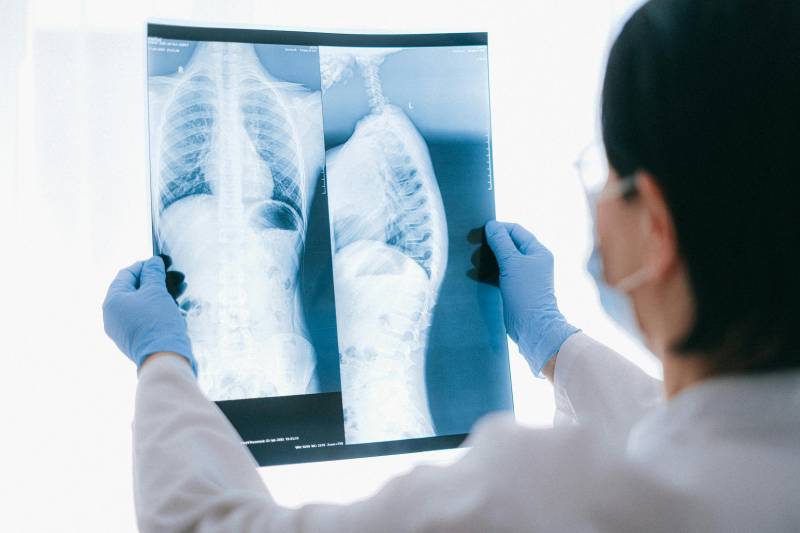
World Cancer Day, on February 4, has again turned the spotlight on lung cancer in Spain and on a risk factor many people have never heard of. Specialists estimate that around 3.8% of lung cancer deaths in the country, close to a thousand cases a year, may be linked to exposure to radon gas. In regions with the highest exposure, such as Galicia and Extremadura, that share can rise to about 7% of all lung cancer deaths.
Lung cancer is now the leading cause of cancer death in women in Spain for the first time, ahead of breast cancer. Tobacco remains the main culprit and is responsible for about 90% of lung tumours, but experts stress that radon is the main lung cancer risk factor for people who have never smoked and the second most important for smokers, after tobacco itself.
What is radon and where is it found?
Radon is a radioactive gas that forms naturally in certain rocks in the Earth’s crust, particularly where there is uranium in granite. It seeps from the subsoil into buildings, accumulating mainly inside homes. It has no smell, taste or colour, so you cannot detect it without a test. Doctors explain that the gas emits alpha radiation and that when we inhale the particles they hit the lining of the lungs and damage DNA, which “can generate genetic alterations that may lead to lung cancer.”
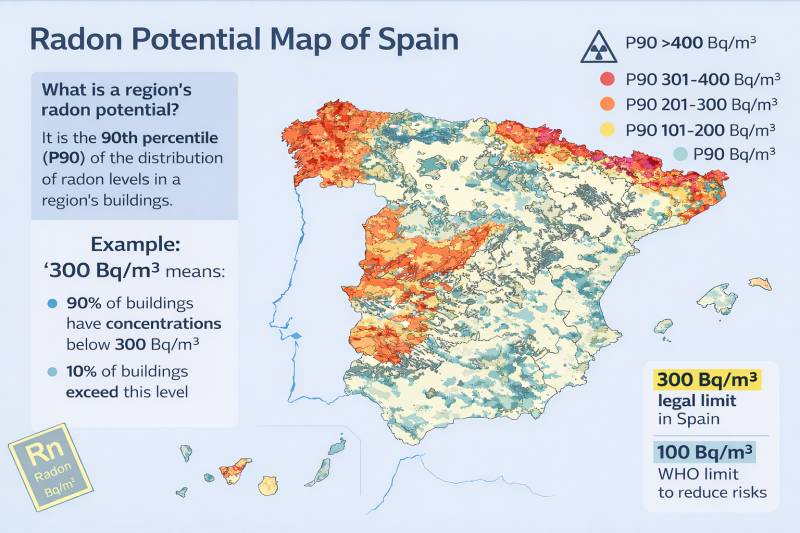
The Nuclear Safety Council drew up Spain’s first national radon potential map in 2017 using around 12,000 measurements, geological information and natural radiation data. According to that work, roughly 17% of Spanish territory has elevated radon levels and the areas most affected are Galicia, Extremadura, the Community of Madrid, Castile and León and the Canary Islands. The highest levels are generally seen in north west Spain, northern and central Extremadura, parts of Castile and León, northern Madrid and some Pyrenean and Costa Brava zones.
The map highlights municipalities where at least 10% of homes on ground and first floors are expected to exceed 300 becquerels per cubic metre, the legal reference level in Spain. The World Health Organization recommends aiming for an annual average of 100 Bq/m³ where possible to minimise health risks.
Why maps are not enough
Even so, scientists are cautious about relying too heavily on maps. One oncologist involved in recent research describes radon levels as “very heterogeneous” and points out that two neighbouring houses can have very different results depending on cracks, construction details or the rock directly underneath. She warns that maps may “overestimate the levels in some sparsely populated areas” while downplaying small but densely populated zones.
A physicist who studies radon agrees and calls current maps “very inaccurate because they contain little data.” He stresses that “high radon levels can exist anywhere” and that “you can never use a map to determine whether a building has a problem or not.” The only reliable way to know is to measure the gas inside each property.
Population density and building type also change the picture. When researchers adjusted for building height, they found that the apparent risk in places like Madrid, where many people live in multi storey blocks, fell sharply because upper floors usually have lower radon levels. By contrast, rural municipalities dominated by single storey or single family homes remained in the high risk category because more residents live close to the ground.
Experts explain that radon levels fluctuate over hours and days, so long term measurements are essential. The recommendation is to use passive detectors for at least three months, preferably in autumn or winter when homes are more closed up, to obtain a realistic annual average. These tests should be carried out by accredited laboratories, in a similar way to a gas inspection.
The specialists also underline that the concern is long term exposure, not brief visits. One physicist notes that even if a building shows a short term reading as high as 3,000 Bq/m³ “you can go in perfectly fine,” because “the problem is long term exposure,” which is why regulations focus on yearly averages. He also reminds us that “there is no building with zero radon.”
From a health point of view, oncologists say that radioactivity from radon and other sources “has no safe limit.” The longer someone is exposed and the higher the dose, the greater the chance of developing cancer. They add that radon interacts with other risks rather than acting alone, which is why its main impact is seen in smokers and ex smokers, even though it is also the leading cause of lung cancer in people who have never smoked.
Spanish rules so far have mainly targeted workplaces and new buildings, and specialists argue that regulation has arrived “late and poorly,” scattered across several decrees and plans. They believe authorities need to invest more in explaining the risk and encouraging measurements, especially in ground floor premises open to the public and in homes in priority areas.
For now, the clear message this World Cancer Day is that radon is an invisible hazard which can be measured and, in many cases, reduced with relatively simple building adjustments once it has been identified.


















 World Cancer Day, on February 4, has again turned the spotlight on lung cancer in Spain and on a risk factor many people have never heard of. Specialists estimate that around 3.8% of lung cancer deaths in the country, close to a thousand cases a year, may be linked to exposure to radon gas. In regions with the highest exposure, such as Galicia and Extremadura, that share can rise to about 7% of all lung cancer deaths.